
I had watched "The Maltese Falcon" (1941) this past summer, as I am a sucker for film-noirs, and was thoroughly impressed with it. I was curious then to see what some of John Huston's other films had to offer. The three films I chose were, "The Treasure of the Sierra Madre" (1948), "The African Queen" (1951), and "The Man Who Would Be King" (1975). To be honest, I picked the three films randomly at first, but I soon realized that the three while each individual in their own way, had overlapping themes and aspects that I found rather interesting.
"The Treasure of the Sierra Madre" (1948) is story set in the 1920's about three men who set out to strike it rich panning for gold in the Sierra Madre Mountains. Starring Humphrey Bogart, and Huston's father, Walter Huston (who won an Oscar for his role), the film depicts mankind's perpetual lust for gold and wealth, with the three men willing to set aside any of their remaining morals in order to get rich. "The African Queen" (1951), set during the start of World War I in the heart of Africa, also stars Humphrey Bogart, and the headstrong Katharine Hepburn, two people who unite together against all odds, to contribute to the war effort in any way they can. Lastly, "The Man Who Would Be King" (1975) stars, Michael Caine and Sean Connery, two ex-British soldiers who set out to find treasure in Kafiristan, but find themselves treated like Gods by the natives who have never seen white men before.
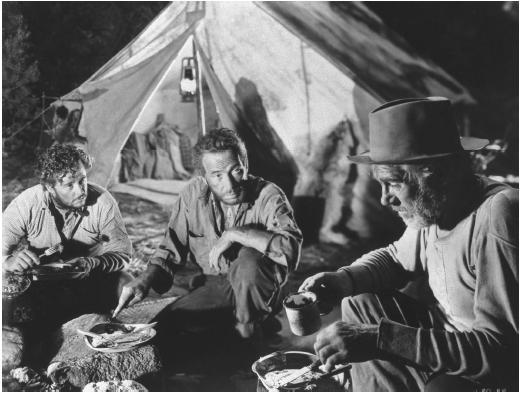 |
| The Treasure of the Sierra Madre |
| The African Queen |
One thing I was found that was interesting and perhaps explains why the films have such a nostalgic and swashbuckling feel to them, is that they were all based on novels. Who hasn't ever read a book, and then been so lost and immersed in the world that is presented on the page? Then, through Huston's brilliant direction, he is able to transfer this idea of immersion, from the page, to the screen wonderfully. One key element to this fluid transfer is the setting. Few scenes in all three movies were shot on stages or sets, instead, Huston chose to shoot mainly on location for the three films. This adds to the sense that we are actually there and are participating in this adventure with everyone on screen. There is a series of shots in "The Man Who Would Be King" for example, that do a fantastic job of setting the scene, and giving the audience a great sense of what the setting is like. We see Caine and Connery trudging through blizzards, hot sandstorms, or walking on narrow paths, with large canyons hoping to swallow them up if they fall. Or, in "The Treasure of the Sierra Madre" the prickly cacti that surround the three men, serve to foreshadow the stinging attitude the three men will soon have towards each other.
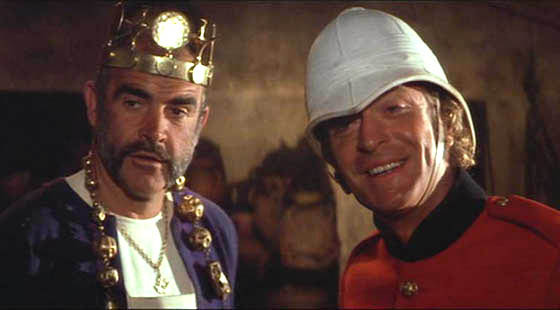 |
| The Man Who Would Be King |

Ultimately, the films are tales of adventure in the purest sense. The stories presented on screen send us hurdling into unknown regions, with each situation asking forcing us to ask ourselves, "What would I do in the same situation? Would I betray my friends for gold? Would I risk my life to sink a German naval boat with homemade torpedoes? Would I take advantage of naive natives to become their king?" I love movies that make you think during the viewing and then afterwards, your mind is still racing. Huston effortlessly harnesses the idea of exploration and the thrill that comes with it, which makes for an extremely enjoyable experience. Anyone who hasn't seen one of his films, I highly recommend them after watching these three.

Great job, Doug. Nice balance of abstract and specifics. I'm not extremely familiar with Huston's work, but I have seen a few of his films. I love the Maltese Falcon. I think it's done so well; but, to be honest, I was pretty darn bored with the African Queen. It just didn't do it for me at all. But, overall, I think you're right--there's a sense of adventure and intrigue to Huston's films. Nice job analyzing them.
ReplyDelete