Sunday, March 23, 2014
MYST #2: Dallas Buyers Club
Going into this movie, I had very high expectations. The movie garnered a lot of buzz and praise during the past few months, so I was expecting to be blown away. Yet, as I should have known, it didn't live up to the lofty standards I had naively set for it. However, that's not to say I didn't like it. I actually thought it was quite good, but I wouldn't put it in the same echelon of other favorites of mine.
The movie based on a true story, spans several years in the mid 1980's to early 1990's, the height of the AIDS epidemic. Set in Texas, we follow blue collar man, Ron Woodroof, played by a magnetic Matthew McConaughey, who after being diagnosed with AIDS takes action to make sure both himself and other AIDS sufferers get the medication they need. Woodroof, initially given 30 days to live by doctors, heads south of the border, and eventually global in order to secure non-FDA approved medication. He then sets up a "club" where members pay a flat monthly fee, and in return get however many drugs they need.

Assisting him in this business venture is another AIDS patient, trans-gender Rayon, played by Jared Leto. They are an unlikely duo as Woodroof is an adamant homophobe, but who later learns to appreciate the help and friendship Rayon selflessly provides. Also, in the film is Jennifer Garner in a supporting role, who plays a sympathetic doctor to the pair, and I thought gave an underrated performance in the film, but was overshadowed by the two male co-stars' work in the film.
The acting in the film was what stood out the most to me, and obviously the quality did not go unnoticed during awards season. McConaughey goes out of his rom-com comfort zone again in choosing this role, and it obviously paid off. Recently he has taken a more dramatic approach to acting and has demonstrated he has the acting chops to handle a heftier role. Indie films like this one and Mud (2012), which both feature southern men are right in his wheelhouse, where he can speak with that long drawl we have all become so accustomed to. However, I would like to see him take on more dramatic roles in the future where he doesn't use a southern accent, but it's unlikely as that seems be a trademark in the same vein as Jimmy Stewart's country boy persona. I know many will also dismiss the acclaim for this film as it was highly publicized that both Leto and McConaughey lost a lot of weight for this film, which many see as a shortcut to cashing in come awards time. Having seen the film though and many of the other contenders for awards this year, in my opinion, I do feel that the praise was merited.
Operating on a very measly budget of $5 million dollars, I read that director Jean-Marc Vallée used only natural light in the film. Therefore, the film looked very real, like a documentary, which added rather than detracted from the film, as it highlighted the bleakness of the diagnosed, burdened with the disease that permeated and affected their every day lives.
The cinematography was also done rather well. One scene I thought was very effective took place in Ron's trailer. Ron, barely functioning after a night of cocaine and booze, watches as his friend and two ladies participate in an act he can longer enjoy (that's as detailed as I'll get), and from Ron's point of view the camera slowly pans from his friend and the females towards a calendar with the 30th day circled. At this moment, Ron basically wakes up to his situation and the gravity of it, deciding not to spend the last month of life he's been given by his doctors, sitting around doing cocaine and getting drunk. I thought that this scene was very subtle, but still important and delivered a strong message to the viewers.
This movie though did have some flaws. I felt that the last third or so of the film was rather jumbled, seeming like the director changed his mind a few times about what kind of movie he wanted it to be. At times it reminded me of the movie Catch Me if You Can (2002) with McConaughey traveling to Japan to get more medication disguised as a pilot, while I wondered how he acquired this outfit, and how he had suddenly turned into a con-man able to get over the border with thousands of pills telling the DEA that it was all his and he wasn't going to distribute them. Also, by the end I thought it tried tackling a theme that had been done countless times in other films that were focused solely on that theme, while this film just kind of threw it in at the end. That theme specifically, was the greediness and corruption of large-scale government sectors like the FDA. I would have liked it if it had just stayed more focused on the characters, instead of also rather ineffectively trying to condemn the FDA.
I think that this is one of those films that I like, but I don't love, but it's hard to say why. There was just something missing, but I'm not sure what. Perhaps I'm just too picky. I do think that this movie shows a big transition for McConaughey's acting career and a large departure from his past rom-coms like How to Lose a Guy in 10 Days (2003), which may disappoint many of his female fans, but for me, I'm excited and looking forward to see what he'll do next.
Overall I give this an 8/10.
Sunday, March 9, 2014
Formal Film Study: Billy Wilder
I had never seen a Billy Wilder film before this. I guess the reason why I picked him at first was because The Apartment was one of the top 250 films on IMDb I hadn't seen yet. So, getting past my lame reason for choosing him, I chose to watch The Apartment (1960), Sunset Boulevard (1950), and Some Like It Hot (1959). I decided on these three films because I felt that they were his most well-known and would have the best demonstration of his unique style.
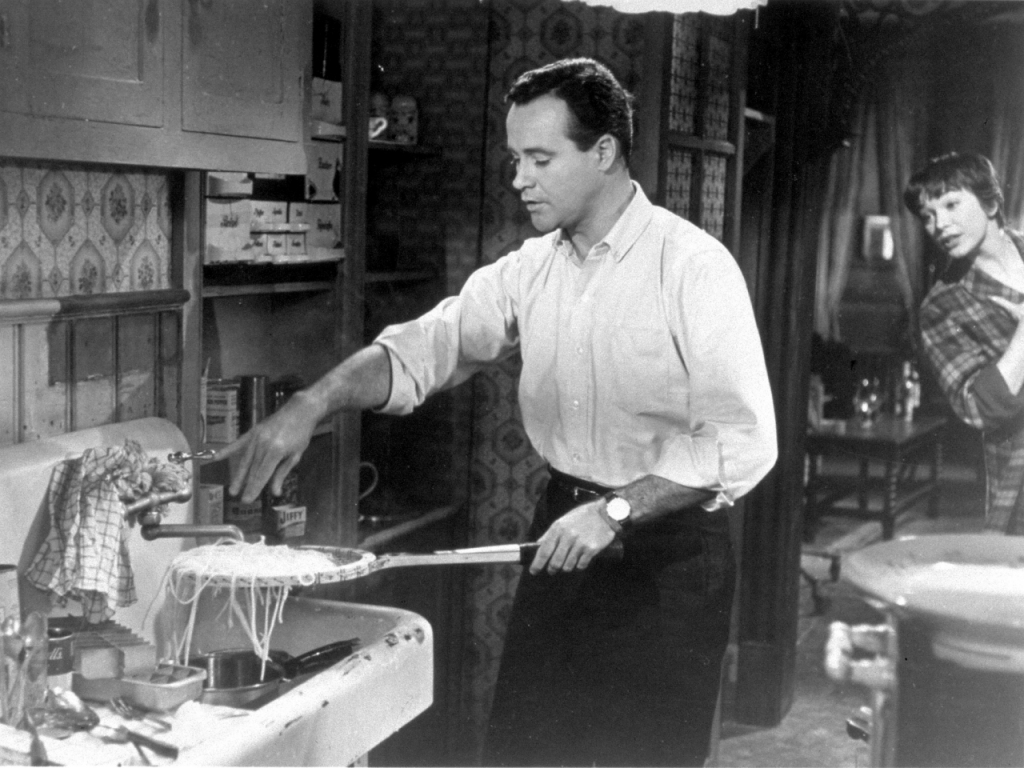
I watched The Apartment first because that was the film I was most familiar with. This film depicts Jack Lemmon doing his trademark average Joe character who can't say no to letting his bosses use his apartment to have affairs in, while they promise future success for his loyalty. Sunset Boulevard I felt was the densest of the three as it is a realistic and rather sharp look at a B-movie screenwriter who gets taken in by an aging and mostly forgotten silent film star, while exposing the often overlooked darker side of Hollywood. Some Like It Hot also features Jack Lemmon, and Marilyn Monroe, who gives a very good performance, and is about two men who go on the run disguised as women in an all-female band after witnessing the St. Valentines Day Massacre.
The Apartment
The writing of the three films was what stood out to me the most. Besides being director, Wilder co-wrote all three films. He won Oscars for writing for Sunset and The Apartment, and was nominated for Some Like It Hot. All three films are heavy on dialogue and each have many memorable lines. My favorite from the three was, "I am big. It's the pictures that got small" (Sunset Boulevard) spoken by Gloria Swanson. There is also quite a bit of humor injected into all three, specifically Some Like It Hot since it is a straightforward comedy, but the humor isn't simple. I felt stupid a few times for laughing a few seconds later than I should I have because it took me some time to get a joke. For example, Lemmon is talking to his boss who says, "Ya know, you see a girl a couple of times a week, just for laughs, and right away they think you're gonna divorce your wife. Now I ask you, is that fair?" while Lemmon then responds, "No, sir, it's very unfair... Especially to your wife." Besides humor, the dialogue lacked any of the typical campiness many of the films of the same time were plagued with. The words, along with the performances, at times seemed frighteningly real.
Sunset Boulevard
Another thing I thought seemed consistent throughout Wilder's films was the cinematography. The medium shot was heavily employed in all three films, as Wilder seemed to prefer to keep the audience from getting too close to the characters. Rarely were there close ups in any of the films. A scene that was both funny and well shot was when Jack Lemmon and Tony Curtis in Some Like It Hot are arriving at a train station and are wearing high heels for the first time. Wilder films them walking from the waist down, giving us a good luck at their rather manly legs struggling to stay balanced in their new shoes. Also, Wilder often kept the camera steady. Only slightly panning at times, like when Lemmon goes to answer his phone in his apartment in the middle of the night as an executive calls to make a late booking. The often stagnant camera I thought was done because it allows the audience to really focus on the characters and highlights dialogue, rather than action.
Some Like it Hot
I found myself at times in awe of what Wilder was able to get away with in terms of content in his films, but immensely satisfied, that he pushed the boundaries at the time, as it gave the films great depth and added to the quality. I was glad that Sunset Boulevard didn't try and sugarcoat anything, as a main point of the film was that it was showing Hollywood without all the glamour. A scene I think shows a good example of this is when Gloria Swanson's character attempts suicide by slitting her wrists. The movie doesn't show the act, but shows the aftermath and how distraught she is, adding to the character's complexity. I think that scenes like this, the entire premise of The Apartment, and the many references to sexuality and sex in general in Some Like it Hot, demonstrate how Wilder didn't care if his movies pushed the limit for what was allowed, instead letting the magnificence of his films not be detracted by censorship.
Yet, at the core of these films, I found something rather interesting. I noticed that all three films were about people pretending to be something different than who they really were. Some Like it Hot is the most obvious example of this, with the men pretending to be women. Sunset Boulevard is tells the sad story of a woman who believes she is an "ageless star", when in reality she has all but faded into the universe. While, in The Apartment Lemmon's character, Baxter, lets his neighbors and almost everyone else he meets think that he is a womanizer, and the trysts happening almost nightly in his apartment are of his doing. While researching Wilder's life, I discovered that he was a first just a writer, but then became a director too, because he felt directors were misinterpreting his work. This shows how since he at one point felt that he was being portrayed as something else (through his writing), he felt that this feeling of misrepresentation was a great source for new material in his later films.
I think Wilder does a great job of balancing reality with fantasy. His films seem to be right on the edge of believable and fake. Originality is essential in his films. The stories seem so familiar, but still so fresh. His films don't seem dated at all, even though they are all 50+ years old, and I think a major factor they stand up to the test of time is because of the originality of the films. Perhaps Wilder is trying to say that our lives aren't so boring after all, and there is something exciting if we take a second glance.
Thursday, March 6, 2014
1935 Film Project: "The Golddigger"
1. This movie is about a struggling and broke actress played by Jean Harlow, who has to go to the bank to solve her financial problems. There she comes up with a solution, however it isn't very moral. She overhears three brothers played by the Marx Brothers discussing a large fortune they have just inherited. She then hatches a scheme with her boyfriend played by William Powell, to seduce one of the brothers so that she can marry one of them and get their money. She then proceeds to go on many dates with the brothers, with each occasion containing numerous comical and ridiculous situations that the Marx brothers are known for. The brothers are somewhat naive though, and end up losing all their money. Yet, the movie shows how even though they aren't rich anymore, they are still happy.
2. This will be a screwball comedy. It will be similar to the academy award winner, "It happened one night". The Marx brothers fit perfectly in this genre because screwball comedies have a lot of slapstick comedy, which is one of their fortes.
3. MGM is our studio because they had the Marx brothers contract and have a large budget if needed for certain comedic scenes, but probably won't need a huge budget since it is just a comedy.
4. We chose Jean Harlow as the lead because she is someone who can add sex appeal, but also has a sinister side to her. William Powell is supporting because he also has a face that you just can't trust. For director, we chose Leo McCarey because he directed "Duck Soup" so he has a good feel for the Marx Brothers' comedy. Our cinematographer is Gregg Toland. He is very good at utilizing different angles and manipulating deep space composition. This is our focus because there will be many opportunities to have a comical situation going on in the background, while something plot wise happens in the foreground.
5. Our movie won't really be affected too much by the Hays Code. While the Marx Brothers sometimes like to use suggestive or double entendre language, they are more than capable of adapting their comedy style to be more family friendly.
6. There weren't any things that I disagreed with in my group.I just wish I had come up with a better title, because I think I could thought of something more clever.
Subscribe to:
Posts (Atom)